
Marvell has tripled in twelve months and still trades 28% below where it stood in June. Both halves of that sentence matter, because the stock has already run a full boom-and-bust cycle inside a single year: up 233% to a $316.43 closing peak on 4 June, down 48% to $163.40 by 29 July, and back to $237.04 at Friday’s close. Our 12-month range is a $340 bull case against a $150 bear case. The reason the spread is that wide is a single document filed on 19 August that almost nobody has read past the headline — a warrant issued to Google whose vesting schedule quietly discloses how big Marvell thinks its custom-silicon business can get, and how much of the upside it has already given away to get there.
Here is what the filing actually says, and the arithmetic that follows from it. On 29 July Marvell and Google signed a commercial agreement covering custom semiconductor products across “a comprehensive range of custom silicon programs that attach to the TPU ecosystem.” On 18 August Marvell issued Google a warrant over 58,970,907 shares at an exercise price of $206.58. Only 1,360,867 of those shares vest on time. The other 57.6 million vest on purchases, “in 240 equal tranches, with one tranche vesting for each $500 million in Custom Products revenue,” running from the third quarter of fiscal 2027 to the end of fiscal 2033. Multiply it out: full vesting requires $120bn of custom-product revenue from Google. Marvell’s most recent quarter annualises to about $9.7bn of total revenue from every customer and every product line. The warrant is, in effect, a disclosed revenue ambition roughly 12 times the company’s current annual run-rate, and the price of pursuing it is 6.6% dilution handed to the customer.
Key facts
- Last close $237.04 — up 233% over twelve months, but 28.1% below the $329.88 intraday high of 18 June — stockanalysis.com, 21 August 2026
- Google warrant over 58,970,907 shares at $206.58, exercisable to 18 August 2033 — Marvell Form 8-K, filed 19 August 2026
- 240 vesting tranches, one per $500m of Custom Products revenue — implying $120bn of Google revenue for full vesting — same filing
- Q1 FY2027 revenue $2,418m, up 27.6% year on year; gross profit $1,261m, up 32.4% — Form 10-Q for the quarter ended 2 May 2026
- Operating income $339m but net income only $34m, down 80.6% year on year — diluted EPS $0.04 — same filing
- R&D $652m, up 28.5% — 27.0% of revenue — same filing
- Peak-to-trough drawdown of 50.6% between 18 June and 29 July 2026, followed by a 45% recovery — FinanceFeeds calculation from stockanalysis.com data
What the Google warrant actually tells you
Warrants issued to customers are not new in semiconductors, but the structure here is unusually informative. Marvell did not issue Google a fixed block of equity for signing. It issued a schedule that pays out only as Google buys, in $500m increments, over roughly six and a half years. That design tells you three things the press coverage has not.
First, the scale Marvell is underwriting. Nobody constructs 240 tranches unless the counterparty and the issuer have discussed a number in that region. $120bn over the period to fiscal 2033 is roughly $18bn a year at full vesting — more than Marvell’s entire current revenue base, from one customer.
Second, the strike is a floor the market has already cleared. At $206.58 the warrant is 14.7% in the money against Friday’s $237.04. Google’s incentive to keep buying rises as the shares rise, which aligns the two companies — but it also means the dilution is most likely to arrive precisely when the stock is working.
Third, the concentration risk is now contractual. Marvell’s custom-silicon story has always depended on a small number of hyperscaler programmes. This filing converts that dependence into a disclosed, dated, quantified relationship with a single customer, one that also happens to design its own TPUs and could in principle bring more of the work in-house. We covered the competitive read-across when the Google deal first surfaced, including what it implies for Broadcom.
Marvell’s Chief Legal Officer, Mark Casper, signed the filing on 19 August. The warrant itself is Exhibit 4.1, and the company notes that “certain of the exhibits and schedules to this Exhibit have been omitted” — so the commercial terms behind the revenue tranches are not public. What is public is the arithmetic, and the arithmetic is large.
The problem underneath the growth
Marvell’s income statement has an awkward shape. In the quarter ended 2 May 2026 revenue grew 27.6% to $2,418m and gross profit grew faster, up 32.4% to $1,261m — a 52.1% gross margin. Operating income rose 25.4% to $339m. And then net income came in at $34m, down 80.6%, for diluted earnings of four cents a share.
Roughly $305m of operating profit disappeared between the operating line and the bottom line, against a $49m tax charge. That gap is the part of Marvell that the AI narrative tends to skip: a business carrying real financing and amortisation costs from its acquisition history, running R&D at 27.0% of revenue, and converting a 52% gross margin into a 1.4% net margin. The growth is genuine. The earnings are not there yet.
This matters for valuation because it removes the usual anchor. At $237.04 across roughly 893 million diluted shares, Marvell carries a market capitalisation near $212bn on an annualised revenue run-rate of about $9.7bn — roughly 22 times sales. There is no meaningful price-to-earnings multiple to argue about, because there are almost no earnings. Every valuation argument for this stock is therefore an argument about a future revenue number, which is exactly what makes the warrant’s $120bn schedule the most important disclosure of the quarter.
For a sense of how differently the market treats AI silicon with earnings attached, see our Nvidia bull and bear analysis, and for the memory side of the same buildout, Micron.
The timing risk nobody should ignore
Marvell’s fiscal year ends on 30 January, which puts its second quarter of fiscal 2027 — the three months to roughly 1 August 2026 — as yet unreported. The most recent results on file are for the quarter ended 2 May. On its normal cadence, Marvell reports Q2 in late August or early September, which means the next earnings print is days away rather than weeks.
That is the single largest near-term risk in either direction, and it is compounded by two things. The Google agreement was signed on 29 July — two days before the quarter ended — so the quarter about to be reported contains essentially none of its revenue, while the warrant’s dilution is already disclosed. And the first vesting tranche is scheduled from Q3 FY2027, meaning the revenue that drives it has not started flowing either.
Anyone modelling the next print should therefore expect a quarter that looks like the old Marvell, reported into a share price that has re-rated for the new one. The stock fell 5.57% on Friday and was indicated lower again pre-market on Monday, which suggests the market is already positioning for that gap.
| Measure | Bull reading | Bear reading |
|---|---|---|
| Google warrant | Discloses a $120bn revenue ambition | 6.6% dilution, handed to the customer |
| Revenue +27.6% | Accelerating into custom silicon | Only ~$9.7bn annualised, at 22x sales |
| Gross margin 52.1% | Up faster than revenue | Net margin just 1.4%; EPS $0.04 |
| R&D $652m | Buys the next design win | 27.0% of revenue, and rising |
| Volatility | +32.5% in a single session in June | −50.6% peak to trough in six weeks |
| Next catalyst | Q2 print could confirm the ramp | Q2 predates the Google deal entirely |
Concentration, competition and disclosure
Three structural issues sit underneath this equity story.
The first is customer concentration by design. Custom silicon is not a catalogue business. Each programme is a multi-year engagement with one buyer, and the economics only work at volume. Marvell has now formalised its largest such relationship with a warrant, which is efficient for both sides and leaves Marvell’s revenue trajectory unusually dependent on the capital-expenditure decisions of a single hyperscaler.
The second is competition from the customer. Google designs its own TPUs. The agreement covers products that “attach to the TPU ecosystem” — inference accelerators, storage controllers, network interface controllers, memory interface controllers, near-memory compute — which is to say the periphery around Google’s own silicon rather than the core of it. That is a durable position while the TPU ecosystem grows, and a fragile one if Google decides to internalise more of the surrounding stack.
The third is disclosure asymmetry. The warrant is filed; the commercial agreement behind it is not, and the exhibits are expressly omitted. Investors can see the dilution precisely and the revenue only through the vesting schedule. That is legal and normal, but it means the market is pricing a relationship whose actual terms it cannot read.
The $340 bull case and the $150 bear case
The bull case to $340 is roughly 43% above the current price and just above the June intraday high. It requires the Google programmes to begin converting into revenue from the third quarter of fiscal 2027 and the market to start capitalising the $120bn schedule rather than discounting it. If custom silicon scales as the warrant implies, the operating leverage in a 52% gross-margin business is substantial: the gap between a 25% operating-income growth rate and a collapsing net margin closes quickly once revenue outruns the fixed cost base. On that path the stock revisits its June high and the dilution is a rounding error against the revenue it bought. Note that the bull case does not require Marvell to win new customers — only to execute the one it has already signed.
The bear case to $150 is roughly 37% below the current price and sits just below the $162.90 intraday low of 29 July. It does not require the Google deal to fail. It requires only that the revenue arrives more slowly than the re-rating already assumes, while the share count and the cost base grow on schedule. Marvell has demonstrated this year that it can lose half its value in six weeks without any change in its underlying business. A Q2 print that predates the Google agreement, a first vesting tranche that slips, or any moderation in hyperscaler capital expenditure would each be sufficient. At 22 times sales with a 1.4% net margin, there is no earnings floor to catch the stock on the way down.
The honest position between them is that Marvell is now a leveraged bet on one customer’s buildout, priced on revenue rather than profit, going into an earnings print that cannot yet reflect the deal driving the story. That is not a reason to avoid it; it is a reason to size it properly. The market’s own behaviour this year — a 233% gain and a 50.6% drawdown inside twelve months — is the most reliable guide to the volatility ahead.
Frequently asked questions
What is the Marvell (MRVL) share price today?
Marvell closed at $237.04 on 21 August 2026, down 5.57% on the session. The stock is up 233% over twelve months but sits 28.1% below its 52-week intraday high of $329.88, reached on 18 June 2026.
What is a realistic MRVL price prediction for the next 12 months?
Our range is $340 on the bull case and $150 on the bear case. The bull case assumes the Google custom-silicon programmes begin converting to revenue from the third quarter of fiscal 2027. The bear case assumes the revenue arrives more slowly than the current valuation implies, with no earnings floor to support the shares.
What is the Marvell Google warrant?
On 18 August 2026 Marvell issued Google a warrant over 58,970,907 shares at $206.58, exercisable until August 2033. Only 1,360,867 shares vest on time; the remainder vest in 240 tranches, one for each $500m of Custom Products revenue, implying $120bn of purchases for full vesting.
Is Marvell profitable?
Barely, on a GAAP basis. In the quarter ended 2 May 2026 Marvell reported operating income of $339m on revenue of $2,418m, but net income of just $34m — diluted EPS of $0.04, down 80.6% year on year. Gross margin was 52.1% and R&D consumed 27.0% of revenue.
When does Marvell next report earnings?
Marvell’s fiscal year ends on 30 January, so its second quarter of fiscal 2027 covers roughly February to August 2026 and has not yet been reported. On the company’s normal cadence the print falls in late August or early September. The Google agreement was signed on 29 July, so it will contribute almost nothing to that quarter.
How volatile is MRVL stock?
Exceptionally. In 2026 the shares rose 32.5% in a single session on 2 June, peaked at a $316.43 close on 4 June, then fell 48.4% to close at $163.40 on 29 July before recovering 45%. The peak-to-trough drawdown on an intraday basis was 50.6% in about six weeks.
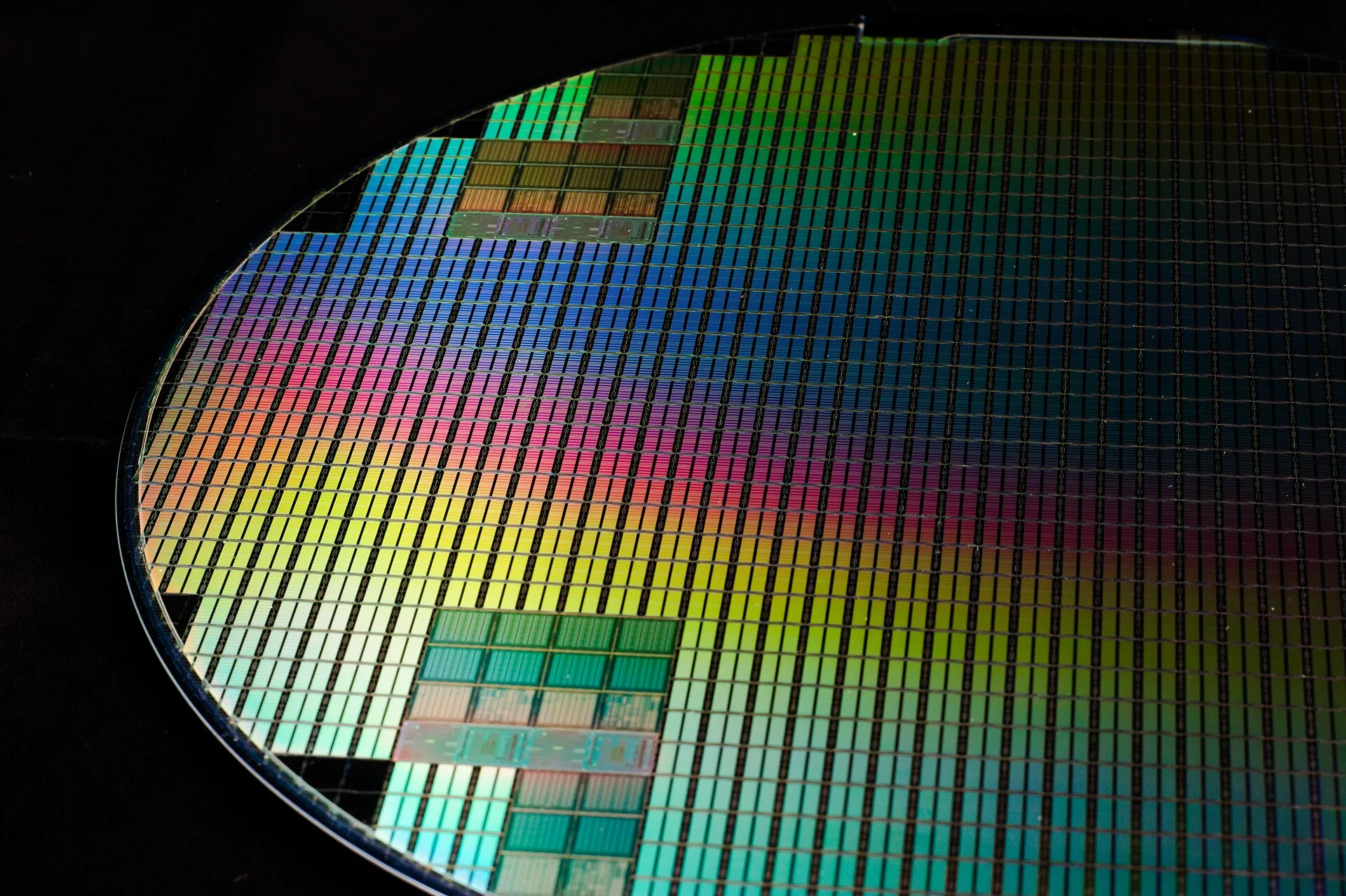
This article is editorial analysis and is not investment advice. Figures are drawn from Marvell’s SEC filings, including the Form 8-K of 19 August 2026 and the Form 10-Q for the quarter ended 2 May 2026; market data from stockanalysis.com as of 21 August 2026. Price targets are FinanceFeeds estimates and may not be achieved. Featured image: a patterned silicon wafer by Enrique Jiménez, licensed under CC BY-SA 2.0, via Wikimedia Commons.
