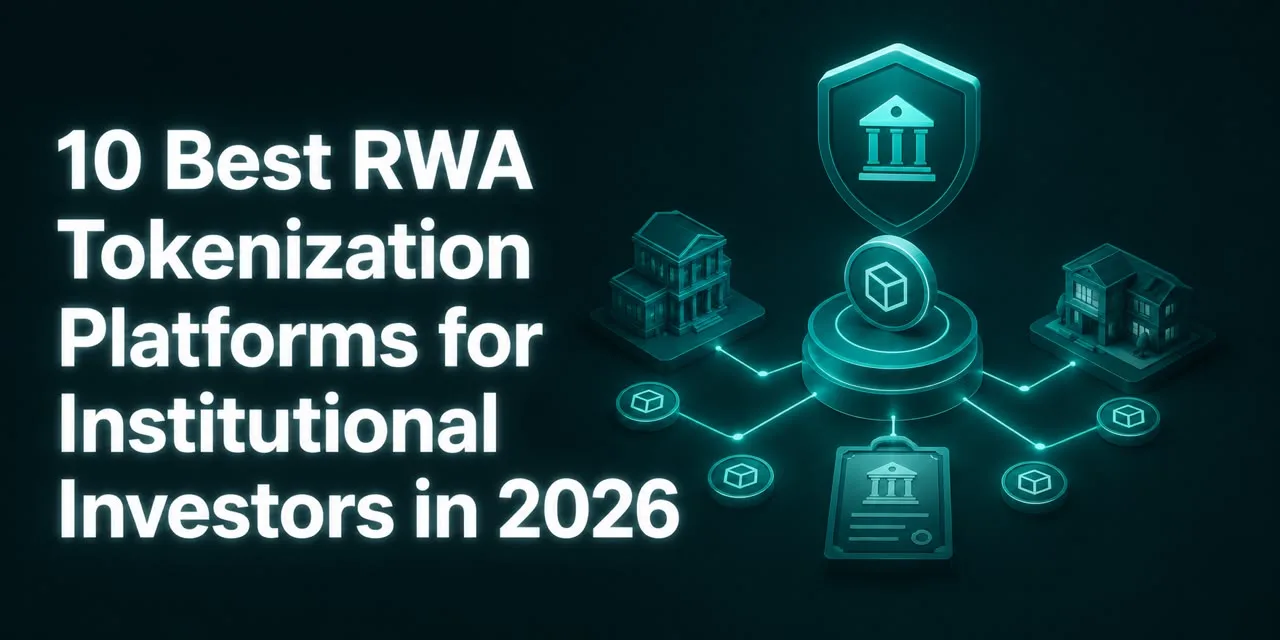
Real-world asset (RWA) tokenization is changing how institutions invest in and manage traditional assets.
By leveraging blockchain technology, physical and financial assets like real estate, private credit, bonds, and investment funds can be represented as digital tokens. This makes it easier to sell, buy, and manage these assets.
Institutional investors are now exploring RWA tokenization to increase liquidity, improve efficiency, and simplify asset management. Tokenized assets also make it feasible to divide ownership into smaller units, allowing for more investment flexibility.
This article explores ten of the top RWA tokenization platforms for institutional investors in 2026 and the features that make them stand out.
Key Takeaways
- RWA tokenization allows institutions to represent real-world assets as blockchain-based digital tokens.
- Tokenization can improve liquidity, transparency, and operational efficiency for institutional investors.
- The best RWA tokenization platforms combine strong security, regulatory compliance, and scalable infrastructure.
- Different RWA tokenization platforms specialize in different asset classes, including real estate, securities, and private credit.
- Choosing the right platform depends on your investment goals, compliance needs, and supported asset types.
What is RWA Tokenization
Real-world asset tokenization involves converting ownership rights of financial or physical assets into digital tokens on a blockchain. These tokens represent ownership or investment rights while enabling assets to be managed more efficiently.
This is the process of creating blockchain-based digital tokens that represent real-world assets. These assets may include company shares, real estate, government bonds, private credits, commodities, or investment funds.
Instead of depending just on paper-based records or traditional databases, ownership information is securely recorded on a blockchain.
How RWA Tokenization Works
The process starts by identifying an eligible asset and confirming its legal ownership. Next, the asset is then valued, and digital tokens are created to represent all or part of its ownership.
Smart contracts manage vital functions like investor rights, ownership transfers, and transaction rules. Investors can buy, sell, or transfer tokens according to the platform’s requirements and applicable regulations.
10 Best RWA Tokenization Platforms for Institutional Investors in 2026
Here are some platforms to check out:
1. Securitize
It provides a comprehensive space for issuing, managing, and trading tokenized securities. This platform offers regulatory compliance tools, digital asset management, investor onboarding, and support for multiple asset classes.
Best use case
Ideal for institutions seeking a regulated platform for tokenizing securities, investment funds, and private equity.
2. Ondo Finance
This is one of the RWA tokenization platforms that focuses on bringing traditional financial products onto blockchain networks. It provides tokenized investment products, institutional-grade infrastructure, and support for blockchain-based financial markets.
Best use case
Ideal for institutions seeking to access tokenized treasury products and other blockchain-based investment opportunities.
3. Centrifuge
This platform enables institutions and businesses to tokenize real-world assets like private credit and invoices. It connects these assets with decentralized finance while improving access to liquidity.
Best use case
Good for institutions focused on trade finance, private credit, and asset-backed lending.
4. Tokeny
It provides end-to-end infrastructure for issuing and managing tokenized securities. Tokeny includes investor management, compliance automation, and support for multiple blockchain networks.
Best use case
Suitable for organizations issuing compliant digital securities across diverse jurisdictions.
5. DigiShares
This platform specializes in real estate tokenization and offers tools for investor management, dividend distribution, and regulatory compliance.
Best use case
Great for institutions managing commercial or residential real estate investments.
6. Polymesh
This is a purpose-built blockchain designed specifically for regulated financial assets. It provides governance features, identity verification, and compliance-focused infrastructure.
Best use case
Suitable for institutions requiring a blockchain designed specifically for regulated securities.
7. Brickken
It enables businesses to tokenize a wide range of real-world assets through a user-friendly platform. Brickken offers smart contract automation, asset management features, and compliance tools.
Best use case
Ideal for organizations seeking flexible tokenization across various asset categories.
8. RealT
It focuses on tokenized real estate investments by enabling investors to buy fractional ownership in rental properties through blockchain technology.
Best use case
Suitable for institutions interested in fractional real estate investment opportunities.
9. Kaleido
This platform provides enterprise blockchain infrastructure that supports digital asset creation, smart contracts, tokenization, and integration with existing business systems.
Best use case
Great for enterprises building large-scale blockchain and tokenization solutions.
10. Fireblocks
It offers secure digital asset infrastructure with wallet management, advanced custody, and transaction security. Fireblocks supports institutions managing tokenized assets at scale.
Best use case
Suitable for institutions prioritizing secure custody and digital asset operations alongside tokenization initiatives.
Key Features to Look for in an RWA Tokenization Platform
Selecting the right platform is vital for successful asset tokenization. Here are some crucial features to evaluate before making a decision.
1. Regulatory compliance
The ideal platform should support compliance with relevant financial regulations, including reporting requirements, investor verification, and securities laws. Solid compliance features help reduce operational and legal risks.
2. Institutional-Grade security
This is important when managing high-value assets. Look for RWA tokenization platforms that offer multi-factor authentication, encryption, secure key management, and regular security audits.
3. Asset custody solutions
Trusted custody services help protect both underlying assets and digital tokens. Some RWA tokenization platforms offer incorporated custody solutions, while others work with trusted third-party custodians.
4. Smart contract infrastructure
Smart contracts automate transactions and ownership management. RWA tokenization platforms should provide well-tested, secure smart contract systems that can manage complex financial agreements efficiently.
5. Multi-asset tokenization support
Some platforms support just one type of asset, while others enable institutions to tokenize multiple asset classes like private credit, real estate, funds, bonds, and commodities.
6. Secondary market integration
A platform that supports secondary trading enables investors to buy and sell tokenised assets easily. This can enhance liquidity and create extra investment opportunities.
Conclusion: Selecting the Right RWA Tokenization Platform for Institutional Success
RWA tokenization is transforming how institutional investors access, manage, and trade real-world assets. By converting traditional assets into blockchain-based digital tokens, institutions can improve efficiency, increase transparency, and unlock new investment opportunities.
Choosing the right tokenization platform is essential for achieving these benefits. Factors such as regulatory compliance, security, supported asset classes, and scalability should all be considered before making a decision on RWA tokenization platforms.
As blockchain technology continues to mature and institutional adoption grows, RWA tokenization platforms are likely to become an increasingly important part of the global financial ecosystem